Research · Logistics & warehouses
Missing waiters, arriving robots: the numbers where they cross
We started this report to cross two data series. We ended up discovering that one of them doesn't exist: the vacancy figure the entire press repeats appears in no official statistic. That gap is also a data point, and a good one.
Key findings
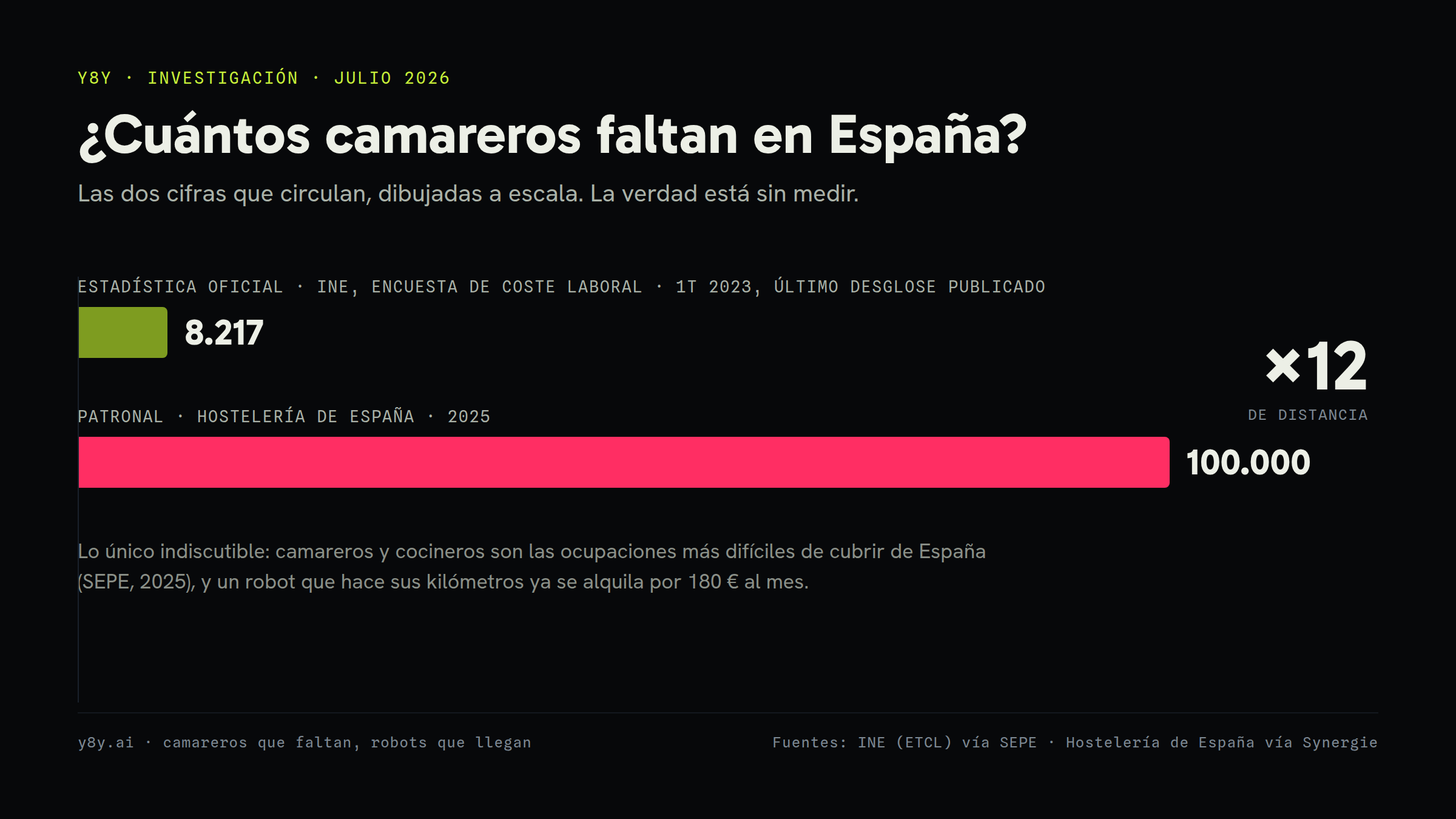
- Nobody knows how many waiters are missing. The official statistic (INE's quarterly labor cost survey) counted 8,217 hospitality vacancies in its latest public sector breakdown (first quarter of 2023); the employers' association Hostelería de España says more than 100,000. A twelve-fold gap between two figures that get cited as if they were the same.
- The 100,000 figure repeated by the trade press is attributed to SEPE, but it appears in no SEPE publication: we traced it to the employers' association Hostelería de España, circulated in 2025 through a press release by the staffing firm Synergie.
- What is official: the 2025 report of SEPE's Occupations Observatory names waiters and cooks as the most frequently cited hard-to-fill occupations in Spain.
- The underlying problem grows however you measure it: unfilled vacancies across the whole Spanish economy have nearly tripled since 2014 (from 56,000 to 155,737 at the close of 2025, the INE series' record), and hospitality vacancies rose 55.7% versus 2019 and another 26.2% year-on-year in late 2023.
- Hospitality is not shrinking, quite the opposite: it went from 1 million jobs in 2000 to more than 1.9 million in 2023, and was still adding over 40,000 year-on-year affiliates in July 2025. Hands are missing precisely because the sector keeps growing.
- The cross with the machine: a server robot rents from about 180 euros a month, against a labor cost of more than 2,000 euros per waiter under the Madrid agreement tables. One position's cost rents eleven robots; what no statistic measures yet is how many have been rented. Nobody counts Spain's server robots either.
This report started as a multiplication and ended as a provenance investigation. The figure the entire press repeats (more than 100,000 hospitality vacancies, attributed to SEPE) appears in no SEPE statistic. Tracing it leads to the employers' association Hostelería de España, circulated through sector press releases in 2025. The official statistic that does exist, INE's quarterly labor cost survey, counted 8,217 hospitality vacancies. Between the official figure and the association's there is a factor of twelve, and both describe something real: INE measures with a survey the sector's own experts consider an undercount, and the association measures with the urgency of an employer who can't hire. The truth is unmeasured, and in a country with two million people working in hospitality, that alone is news.
What no statistical nuance disputes is the direction. Waiters and cooks top SEPE's official list of hard-to-fill occupations, economy-wide vacancies have nearly tripled since 2014, and the sector keeps growing: from 1 million jobs in 2000 to more than 1.9 million in 2023. On the other side of the crossing, the falling curve: in 2019 the server robot was an attraction; today a BellaBot rents from about 180 euros a month and a Dinerbot T10 runs as a service from about $542. The labor cost of a single dining-room position (over 2,000 euros a month under the Madrid agreement tables) rents eleven robots. The robot is not competing with the waiter for the job: it competes with the vacancy, however you count it. What that machine can cover and what it cannot, in our sector guide and the server robot comparison.
Why nobody wants the job: the trade did the math
The causes are no mystery: SEPE's own report lists them, and they sound less like a crisis than an invoice. Unattractive conditions, no generational replacement, and a mismatch between what is offered and what is sought. The detail that explains almost everything sits on the payslip: an agreement-rate waiter in Madrid (level III) generates about 18,348 euros gross a year, roughly 1,310 euros a month across fourteen payments, for a trade of weekends, holidays and split shifts that break the day in two. The sector's job portals place hospitality's average salary around 40% below the Spanish mean. Spain's job vacancy rate is also among the EU's lowest according to Eurostat, less than half the European average: it is not that Spain has candidates to spare, it is that the statistic and the market speak different languages.
The consequence shows in who already keeps the service running: per the sector's studies, one in three workers in Spanish hospitality is foreign, and employment grows precisely thanks to foreign labor. The generational replacement never came; immigration did, and even so the positions go unfilled in season. That is the real context the machine enters: it does not displace a waiter who wants the job, it comes in through the hole left by those who did the math and left.
Where and when the hands are missing: the coastal summer
The shortage is not evenly spread. Staffing-industry studies indicate that in summer close to half of hospitality vacancies go unfilled, with coastal tourist areas and the islands hit hardest: exactly where demand multiplies with the season, housing for displaced workers costs more, and the workday is toughest. The Spanish paradox: the country hosts record tourist seasons with a workforce that cannot grow at the same pace, and every summer the same story returns to the papers with a different number.
That seasonality also explains part of the numbers war. INE's official survey photographs active vacancies in one specific quarter, without capturing the season's anticipated need; the employers' association estimates what the sector will need to hire for the whole summer. They measure different things and both end up in the same headline. For the owner of the seaside restaurant, meanwhile, the question is concrete: find ten people for July, or work out which part of the job can be done by a machine that needs no housing.
The method, in the open
Everything in this report is reproducible from public sources, and each figure's provenance matters as much as the figure. The 8,217 official hospitality vacancies come from INE's quarterly labor cost survey, cited in SEPE Observatory's magazine in an article signed, it should be said, by the secretary general of the employers' association Hostelería de España. The 100,000 vacancies are that same association's estimate, circulated in 2025 via a press release from the staffing firm Synergie and echoed by the trade press as if it came from SEPE. The economy-wide vacancy series (from 56,000 in 2014 to more than 152,000 in 2025) and the waiters-and-cooks podium of hard-to-fill occupations come from the 2025 report of SEPE's Occupations Observatory. The labor cost uses the Madrid hospitality agreement tables (waiter, level III: 18,348.60 euros gross per year) plus employer contributions. The 180-euro monthly rental is a real, current commercial offer from a Spanish Pudu distributor (the same distributor's newer pages list 189).
Two honest gaps this report leaves on the record: no official hospitality vacancy statistic exists that the association itself accepts as complete, and no statistic exists, official or private, of how many server robots operate in Spain. The first is INE's to solve; the second is exactly the kind of count this house intends to do. The full series, with each figure's provenance on its row, is downloadable in the open: the dataset as CSV and as JSON, licensed CC BY 4.0: use the data and cite y8y. This report will be updated with each new release of INE’s ETCL and Turespaña’s affiliation data. Press, data or corrections: hola@y8y.ai. If you quote a figure, quote its provenance too; we did the same.
Frequently asked
How many waiters is Spain missing?
It depends on whom you ask, and that is the news. INE's official statistic counted 8,217 hospitality vacancies; the employers' association Hostelería de España says more than 100,000. A twelve-fold difference. What is beyond dispute is the direction: waiters and cooks are Spain's hardest occupations to fill according to SEPE, and vacancies grow year after year.
Why does nobody want to work as a waiter?
The combination SEPE itself lists: unattractive conditions and no generational replacement. Concretely: about 1,310 euros gross a month across fourteen payments under the Madrid agreement, split shifts that break the day, weekends and holidays worked, and seasonal contracts in areas where housing has grown expensive. It is not vocation that is missing: the offer lost the comparison against other sectors.
How much does a waiter earn in Spain?
Under the Madrid hospitality agreement tables, a waiter (level III) has a base salary of about 18,348 euros gross a year: around 1,310 euros a month across fourteen payments, roughly 14,700 net per year before night or holiday supplements. Job-portal reports place the sector's average around 40% below the Spanish mean wage. Tips aside: in Spain they do not replace the salary as they do in the United States.
Where are the most waiters missing?
In coastal tourist areas and the islands, above all in summer: staffing-industry studies estimate that in high season close to half of the sector's vacancies go unfilled. Where tourism multiplies demand is also where seasonal workers' housing costs most, and the two together leave the tray without hands.
Why are the official figure and the association's so different?
Because they measure different things. INE's survey (ETCL) counts active vacancies at a given moment: positions the company is already recruiting for. The association estimates the whole sector's need for the season, including hiring that is planned and never achieved. Spain's vacancy rate is also among the EU's lowest per Eurostat, and the sector's own experts consider the survey an undercount. A twelve-fold gap between the two figures is the measure of how little we know, and no authority has closed it.
Is immigration solving the waiter shortage?
To a large extent it already has: per the sector's studies, one in three workers in Spanish hospitality is foreign, and the sector's employment grows mostly thanks to foreign labor. Even so, seasonal vacancies still go partly unfilled, which suggests the problem is not only available people but conditions: pay, housing in tourist areas, and hours.
How much does a waiter cost the employer?
More than 2,000 euros a month in Madrid: the agreement tables set a waiter (level III) at about 18,348 euros gross per year, and the employer adds roughly a third more in social security contributions. The worker takes home considerably less: that distance between what the position costs and what its holder earns is part of why the vacancy goes unfilled.
Will server robots solve the staff shortage?
Only part of it. A server robot transports plates: it takes no orders, does no service, handles no bills. It can absorb the kilometers of the vacancies nobody fills in venues with flat floors and wide aisles, and at 180 euros a month the math works. But the part of the trade that is actually missing (the person who looks after the table) is not done by any machine on sale today.
How much does a server robot cost versus hiring?
Rental starts around 180 euros a month (BellaBot) and robot-as-a-service around $542 (Dinerbot T10), against more than 2,000 euros of monthly labor cost per waiter. The honest comparison is not robot versus person but robot versus the transportable part of the job: full models, verdicts and prices are in our server-robot comparison and the sector guide.
Numbers don’t argue. Either the robot did it alone, or it didn’t.
Sources
- Vacantes en hostelería (Emilio Gallego Zuazo, Hostelería de España), Cuadernos del Mercado de Trabajo nº 10: 8.217 vacantes de hostelería según la ETCL del INE; empleo de 1 a 1,9 millones desde 2000
- El ajuste de la oferta y la demanda de empleo 2025: camareros y cocineros, ocupaciones con más dificultad de cobertura; vacantes de 56.000 (2014) a más de 152.000 (2025)
- Notas de prensa de la ETCL: vacantes totales por trimestre (155.737 en el 4T 2025, máximo de la serie; hostelería +26,2 % interanual en el 4T 2023)
- El empleo turístico asciende a 2,98 millones de afiliados en julio (hostelería: +40.157 afiliados interanuales)
- La hostelería en España afronta más de 100.000 vacantes sin cubrir (cifra de Hostelería de España vía nota de prensa de Synergie)
- Niveles retributivos en hostelería: categorías, salarios y convenios (convenio Madrid, camarero nivel III)
- Calculadora del convenio de hostelería de Madrid: coste real por hora para la empresa
- BellaBot precio: renting desde 180 € al mes en España
- Robots camareros por 10.000 € en pago único frente a un camarero de 2.000 € al mes
- La ocupación en la hostelería crece gracias al empleo foráneo (uno de cada tres trabajadores del sector es extranjero)
Keep reading
- Research AMR vs. AGV: the difference and which one your warehouse needs
- Research Robotic surgery: what the da Vinci operates on and in which hospitals
- Research How much it costs to automate a warehouse with robots in 2026
- Research The most famous robot demos that weren’t what they seemed
- Research Teleoperated vs. autonomous: the difference and how to tell them apart
- Methodology How we verify